A Floor, Part 2

November, 2016

A curiously warm autumn has allowed us to work later into the year than we expected. We find ourselves working outside in short sleeves in November, and we’re not usually those folks, those wacky folks who wear shorts all year around (That’s you, Rich W…). It is, in fact, warm or not, the most glorious season of the year in western Wisconsin, when the bugs have been decimated and the breezes begin to rattle those bronzed oak leaves still in the trees.

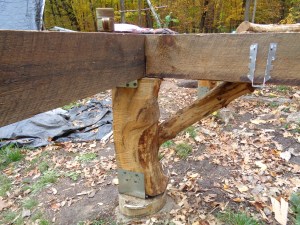
J. has been obsessively bracing his tall support posts with diagonals. He finds himself on a slippery slope…just where, exactly, is the line between a post tall enough to need bracing and a post short enough to get by without it? J., as I have said, leans toward the obsessive. I, however lean toward the negligent side, and am more likely to throw up my hands and say, “Awww, it’s fine…” (Please read my post about nearly burning down my kiln building to see how this personality trait has served me.) All in all, it’s good we’re letting J. take the lead on this one.
dsc00383

dsc00385
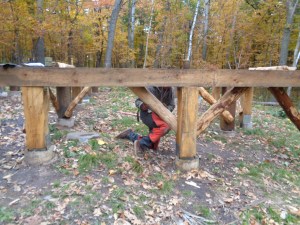
One of the delightfully wonky verticals with its diagonal brace and a joist hanger showing.

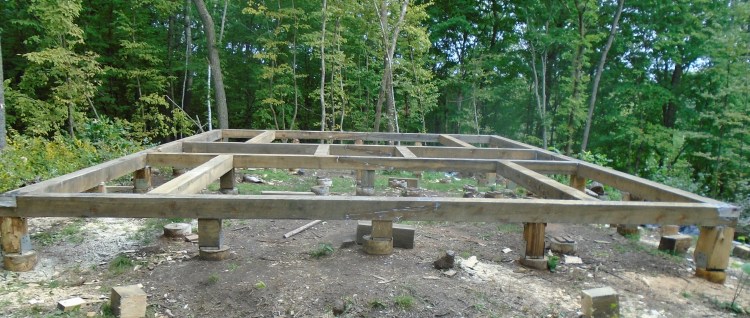
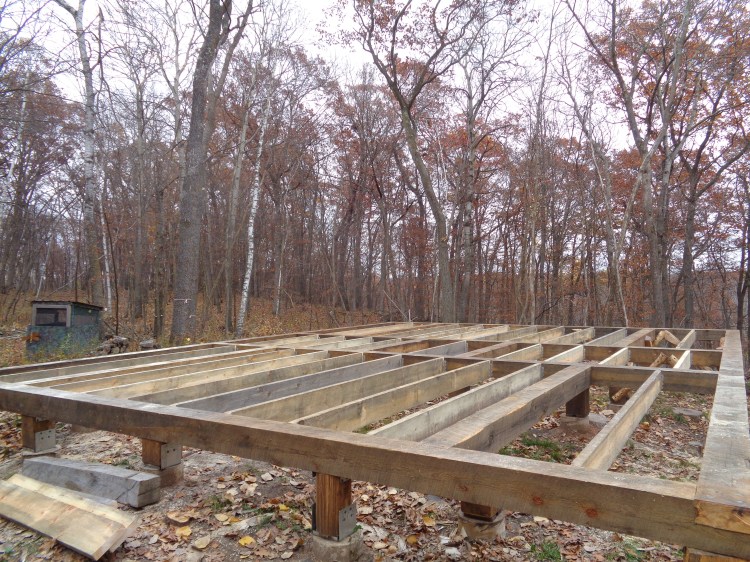
Once “adequately” braced, J. banged in joist hangers and filled in the spaces between the timbers with joists. Typically for this project, this was not as easy as it sounds, since the joists were rough-cut and the hangers are made for narrower stock. So each end of the joists had to be trimmed to fit.

I know what you’re thinking: “Here is where J. and Christy use chisels to do the job in an elegant, quiet way, consistent with their ideals.” Well…winter is breathing down our backs. It happens that a router will also work, and faster. We used a router.
DSC00418.JPG

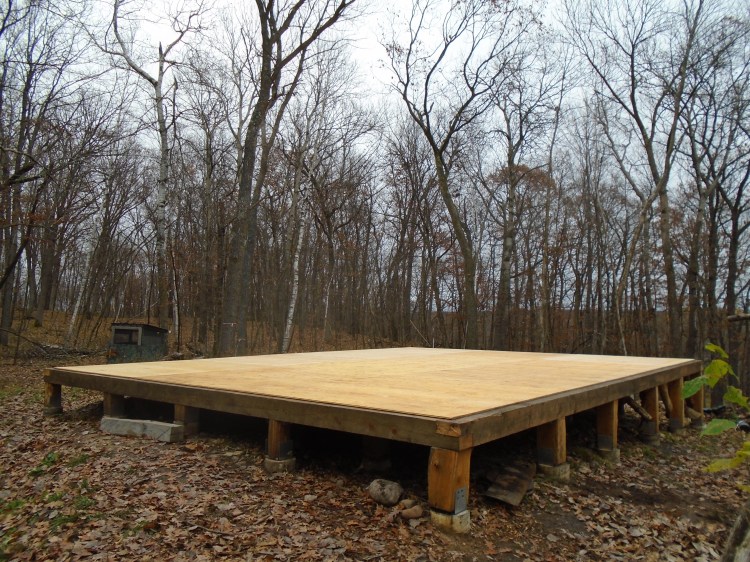
Joists hung, it was just a matter of nailing on some plywood. Here again, we’re a little uncomfortable with the idea of plywood, but this time our reason for compromising is financial. We could go buy hundreds of feet of tongue and groove but we chose to go buy twenty sheets of plywood, delivered. Our neighbor tractored them up the hill for us. Life is full of compromises.
DSC00270.jpg

And suddenly, our wonky handmade structure looks very much like the beginnings of every other building. A little disappointing perhaps, but it won’t stay that way for long.

In fact, we decide to get a jump start on next spring’s work and begin to cut the timbers for our house. So our future home immediately becomes (owing to the fact that it’s now the largest flat place on our land) a platform for chiseling timbers.DSC00284.jpg

Almost too good to be true…so I’ll say it again…we’re starting to chisel the timbers for our house.


On Leaving the City

October, 2016

As I write this, we’re embarking on what will hopefully be our last winter in the city before moving to the Woods. Many people we’ve talked to think we’re crazy to even consider this, so I’ve been thinking a lot about why we’re leaving and if we are, indeed, crazy.

We’ve lived 13 years in our house in a pretty rough neighborhood in the city. During that time on our block, people (some of them children) have died in house-fires, people (and one child) have been murdered. We’ve seen drugs sold, prostitutes plying their trade, guns fired, houses robbed.

Also, we’ve made friends and celebrated birthdays with our neighbors, we’ve cleaned up trash and blockaded the street for parties. In our small lot we’ve practiced for living in the country by raising ducks, experimenting with gardening and composting methods, planting fruit trees, berries, grapes, and wild plants, rainwater harvesting, heating with wood. We’ve renovated our century-old house, built a cordwood masonry studio and a clay pizza oven in the back yard. In short (previous paragraph aside), we’re attached to our little rectangle of the city.

We know it makes ecological sense to stay in the city. Here we can reach almost any place we need by bicycle; by living in an old house we protect wild lands from development; we rub shoulders with people who share our ecological beliefs.

Checking out of the city will force us to critically examine our impacts on the world, for example, just how much water does it take for four humans to live; or, if I am sending my wash-water out to the garden, is the soap I’m using harmful to the soil? We will be cutting out our use of natural gas…but increasing our reliance on gasoline. We’ll be using our own timbers and muscles to build an efficient, green home…but we’ll be building it on previously wild land.

Does the good outweigh the bad? Or are all our justifications for life in the country exactly that, empty justifications of a guilty conscience?

And yet, regardless of logic, we find ourselves drawn to a quieter life. We long to breathe clean air and quit dodging bullets. We long to take responsibility for our needs and wastes, instead of mindlessly hooking up to the urban utility stream. We long to unwind our nerves, strung tight by long fear of violence in the city, and absorb the ease of the trees swaying in the wind. We long to let the children play outside without fences or supervision. We long to see the stars.

For now, we’ll follow our longings. What could go wrong? 🙂

On Faith, or, Why We Do This

If you’re curious about how a Christian ended up living in the woods as a bona fide tree-hugger, read on. Read also Joel Salatin, who calls himself a “Christian libertarian environmentalist capitalist lunatic farmer,”and provides a great apology for those apparent contradictions. And while I don’t label myself exactly that, let me add my voice to the choir of those who place their feet in both the Heaven camp and the Earth camp.

I grew up loving to play outdoors, but I was never an “environmentalist.” I still hate that word; it summons images of people chained to trees, going door to door with petitions, weeping over obscure endangered species. These folks, growing up, were not my people. My people went to church. My people cared for other people, for eternal souls; they were not interested in petitions to save the tigers. In fact they were suspicious of those people with the petitions. Anyone with a petition probably worshiped a thing called Mother Earth, never took a shower, slept in on Sundays or, worse, cleaned up litter on Sunday mornings. Probably they were Democrats.

And then one day, about 12 years ago, my faith took a turn for the worse. I don’t remember why, but every time I opened the Bible to read it, I couldn’t believe what it said. Until then, the word of God had been a given in my life, and time sitting before the Bible was necessary, as for every Christian. But reading the Bible had became a sorry slog, and the God I was trying to read about seemed distant and unintelligible.

At that time I also happened to be reading a book about the prairie. Among many things, I learned about grasses whose roots go 23 feet underground, mining nutrients in the bedrock, and every fall as the plant dies back, its leaves, full of those nutrients, compost and feed the shallower rooted plants. I learned about how wind, rain, fire, bison, insects, and prairie dogs each have a role in shaping the prairie, so that it is a constantly changing, adapting place.

And every time I read became a time of worship. I saw the character of God revealed there, barely fathomed by scientists who spent their lives studying the ecology of the prairie. If, in one ecosystem alone (and one that for all the world looks like a simple plain of grass, plowed up for crops without a second thought), a web of miracles existed without our knowledge, how vast that mind must be that conceived it. I saw a God creating joy, creating secrets that only he understood, for his glory. What a privilege to live on this earth and, if only a little, plumb these mysteries!

[In this blog, I will often refer to the created world of God because by faith I believe that the worlds were formed by the word of God. But I’m not a scientist; I won’t weigh in on the creation/evolution conundrum. Just how exactly God went about creating, or how long it took, I can’t hazard a guess. And to me, it doesn’t really matter.]

Hopefully you can now understand my enthusiasm for this life close to nature, because the closer I live to the created works of God, the more I hope to understand of God’s character and action in the world. It may also be that as we drink water that came to the earth as rain, as we compost our wastes to add nutrients to the soil, as we live a life closer to the seasons and the hours of daylight, we will become more aware of our reliance, as fragile humans, on God’s good gifts.

*

Let me add one final thought to this gentle manifesto. It happens that I’m a solid introvert. If I believe that I have been created as such, and so much ministry work seems tailor-made for the extroverts among us, how can I contribute to the work of God in the world?

Street evangelism? Utter failure.

Inner city ministry? Left depleted.

Ministry to the elderly? Children? I feel awkward and quickly exhausted.

Finally it has occurred to me. The smallest of “the least of these” (to whom Jesus commands us to minister), the one without a voice of its own, the one crushed and downtrodden by too many of the powerful, is God’s created world. Even in our little woods, protected from development and logging by its rocks and hills, we find litter throughout, chunks of cement dumped, piles of dirt left long ago by a road crew.

If we can heal this little bit of land and nourish the life that depends on it, will we indeed be ministering to Christ himself? Perhaps. It would, at least, be a start.


An (Almost) Disaster

October, 2016

The seasons have changed and the weather has cooled enough to fire the kiln again. The summer was incredibly wet, so we were a little dubious about the wood supply, which, though ample, had lain uncovered most of the summer. It wasn’t exactly growing mushrooms, but it was damp. OK, maybe there was a mushroom here and there…

I’ve heard from other wood-firers never to try to fire a kiln with wet wood. Incidentally, I’ve also often heard about potters burning their structures down. I’ve never been one to listen to other people’s opinions.

We did indeed fire that kiln with wet wood. Pine, it appears, burns no matter what, especially when split to toothpick size. After we passed 2000 degrees, it got hard to gain temperature, even with (wet) toothpick-pine. But we had some dry stovewood squirreled away, which did the trick. We got to our peak desired temperature–too hot for the thermocouple, which I withdrew at 2313 degrees, and kept stoking until cone 10 dropped, which happens, I think, around 2350.

Because night comes early in October, we were stoking by feel and by headlamp by the time we were finished. When we went up the hill to bed, we were buzzing with that curious elation that comes from working hard and accomplishing what we knew was a good job. The fire still glowed on our cheeks.

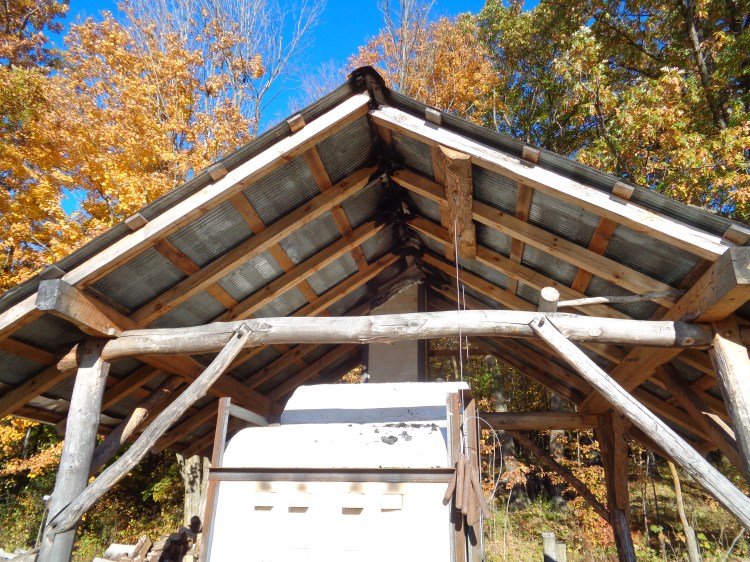
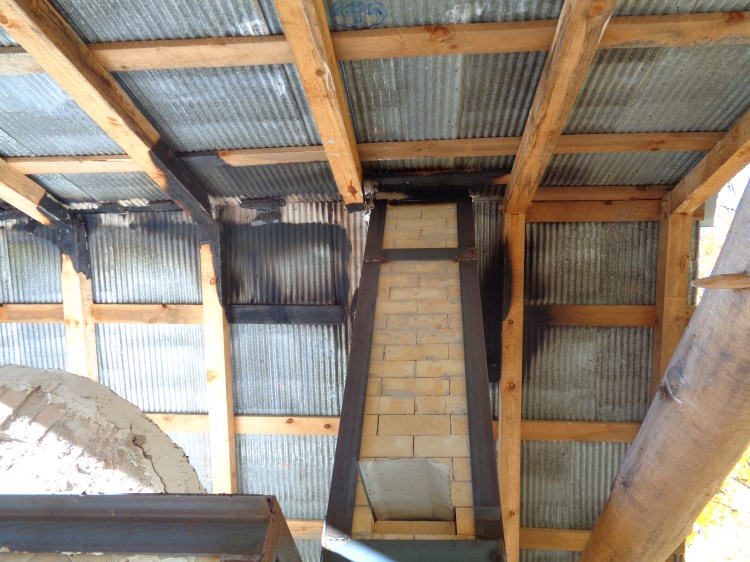
The next morning, we visited the still-hot kiln like an old friend. However, our old friend had cinders on top of its arch… Looking up, we saw that the beams of the roof were burnt. All along the ridge beam, the joists of the roof had caught fire, beginning next to the chimney. Which had been insulated, apparently not well enough.

dsc00391

dsc00393

It was hard, looking up at those burnt beams, to not think of the time we had spent chiseling them by hand.

But it could have been worse…we were grateful to still have a kiln, and a building, however damaged, over it. I imagined the burning embers falling from the roof onto the structural timbers, burning through, and collapsing the whole building. Onto the kiln, which was still hot and would have stoked the fire. The chimney would fall…I shuddered.

Looks like you need to be pretty careful when you send a kiln over 2300 degrees. Hopefully we’ve learned this lesson well enough to build the roof back up and protect it adequately. Who knows, I might start listening to advice from other potters…

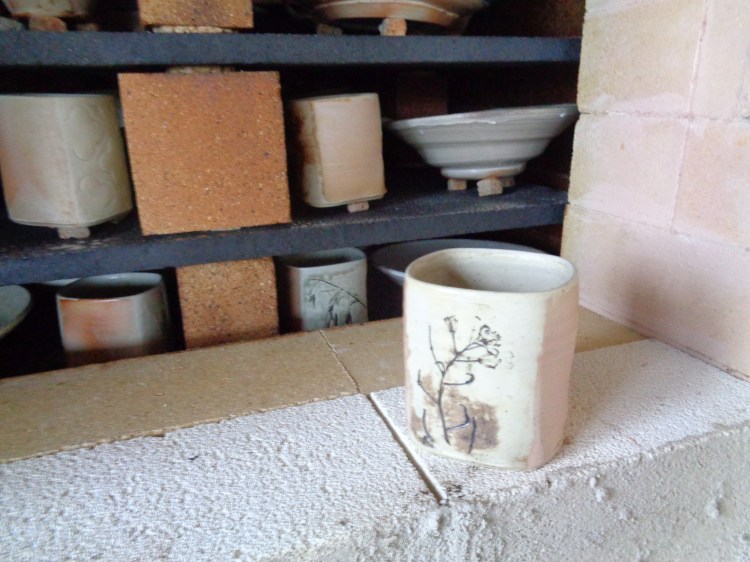
The pots from the firing did indeed turn out well. It was almost worth it. dsc00396

A Floor, Part 1

Summer, 2016

Unless you have personally dug 32 holes in the ground and filled them with concrete that you’ve mixed with your own shovel, you cannot fully appreciate the joy of working above ground, with wood, on work you can see. But I’m sure you can imagine J.’s elation to be cutting wood with his chainsaw again, day by day seeing the progress he makes.

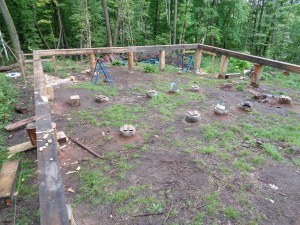
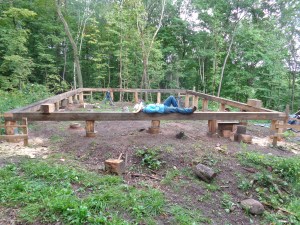
The first layer on top of the cement piers is the platform on which we will build the house. The legs for this platform will be our own white oak (which has some rot-resistance, so it’s perfect if you need some wood near the ground). We’re using odd bits of wood that are too short for the beams of the house, and they’re beautiful chunks, rough-hewn and wacky. They support the more staid horizontal beams, which are pine 8 x 8s from the local lumber mill. Rather than load you up with a wordy description of what we did, I think our progress will be evident by photo:

dsc00292

dsc00291

dsc00294
Time for a little break.

Because of the slope on the site (although about as flat as our woods had to offer), the posts on the east side of the house are about four and a half feet high. No, we’re not expecting flooding on our gravelly hill in Wisconsin, but I can’t deny the similarity between our house and a shack off the beach in the Philippines. Someday it’ll be bike- and garden-storage. For now, the children love playing under the beams, and we’ve been picnicking on them, swinging our legs, happy as clams.

dsc00241
The stringers are up, awaiting joists…