Doing Laundry by Leg (Not by Hand)

May, 2018.
As we’ve continued to look closely at our lives, at the daily needs we can provide with the labor of our own hands, it was only a matter of time before we took a good long look at our washing machine. Or, to be specific, our laundromat habit. I had grown uneasy with it because I had no way to quantify how much fossil fuel or water I was using–they kept coming eternally, as long as I fed trails of quarters into the machines. I had begun to feel my soul slowly sucked out of my body by that weekly pilgrimage to the laundromat. Maybe that’s extreme way to put it. But I dreaded it, so I let the clothes pile up as long as possible before hefting the gigantic pile to the country music den that is our local laundromat.

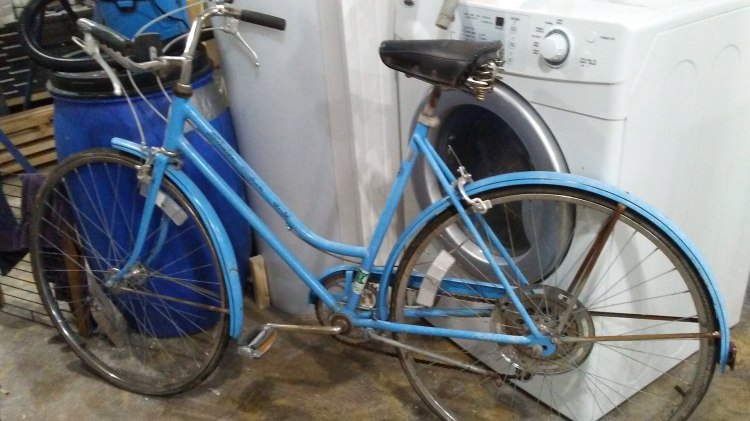
I needed a new solution–one that didn’t involve carting the dirty clothes out of the woods. Or earplugs. Figuring that my legs could provide the motor, I began to troll Craigslist for a non-working washing machine. The man I married being who he is, we already had enough bikes and bike parts to poach for a great many bike-powered machines. Connecting the washing machine with its new motor–a bike–would mean I’d never have to go to the laundromat again. No more need to stockpile quarters; if the fuel ran low, I’d just eat another peanut butter and jelly sandwich.

20171228_090239

It turned out to be a little more complicated than that, but I’ll walk you through, in case you also dislike country music.

20171228_085751
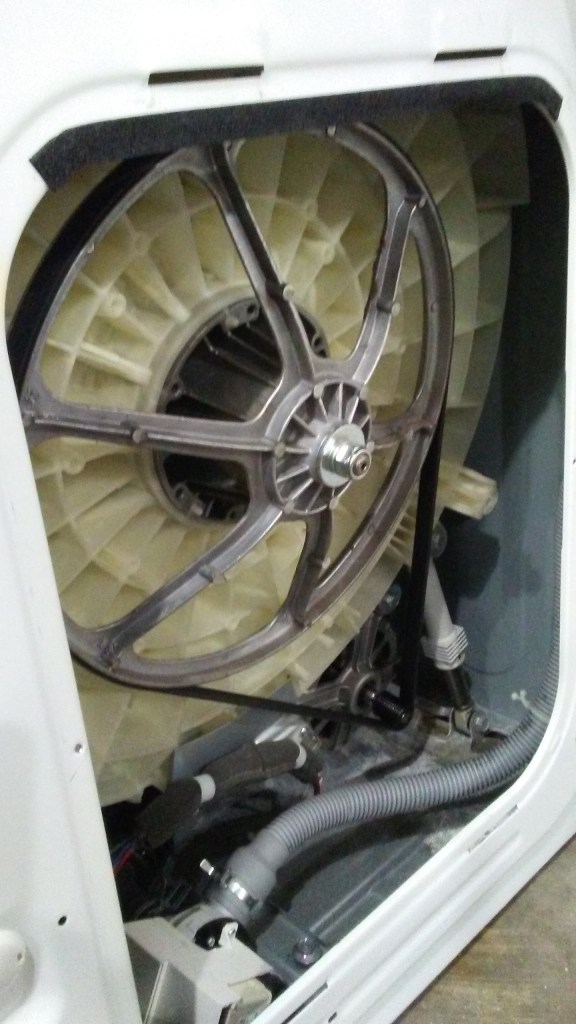
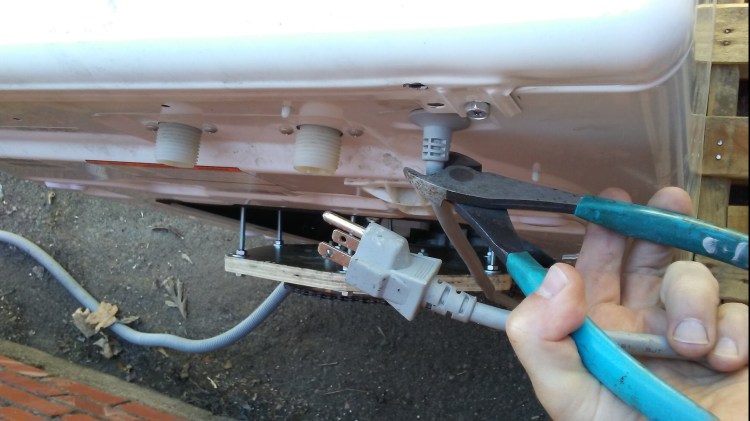
In case you’ve ever wondered, this is what it looks like in the back of a front-loading washing machine. The motor at the bottom turns the rubber belt, which turns the flywheel connected to the back of the laundry tub.

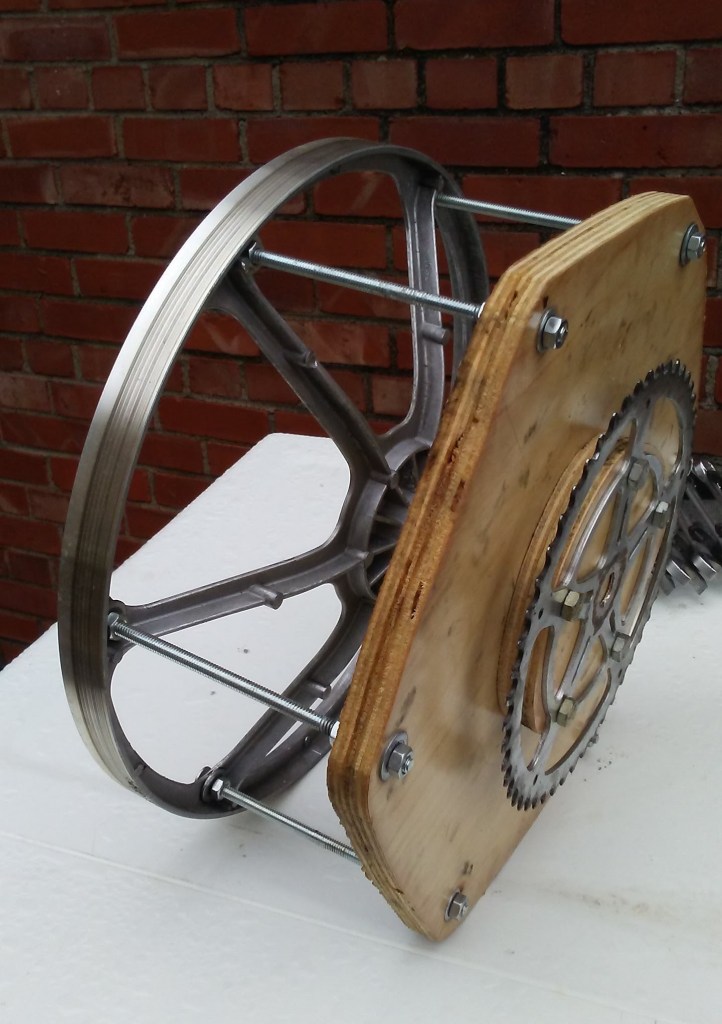
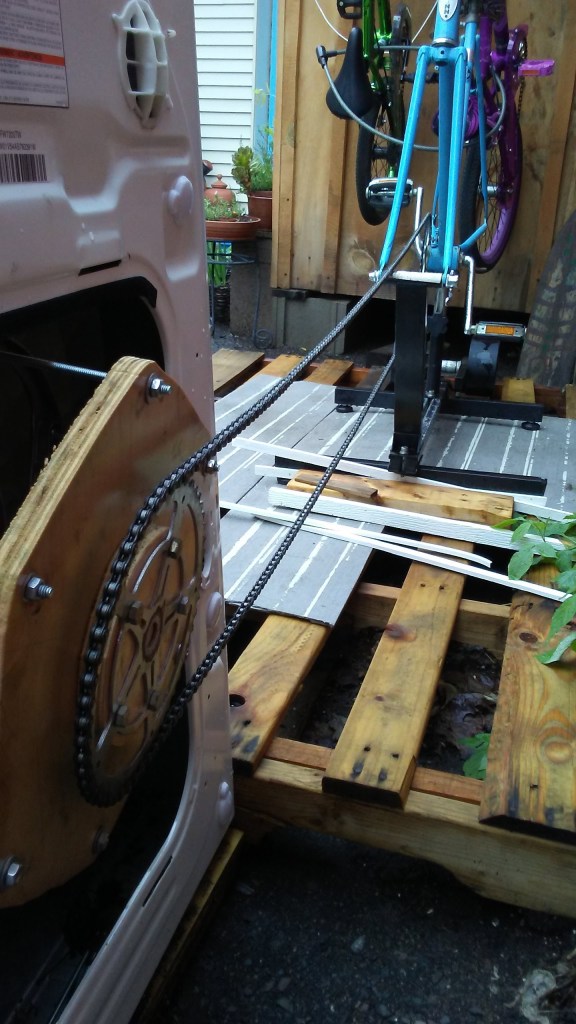
I drilled a hole at the end of each spoke of the flywheel above and inserted a 6 inch bolt into each hole. Then I bolted a plywood circle into the ends of each bolt. This was simply a way of extending the flywheel past the skin of the washing machine, so the bike chain can reach it. I bolted a chain ring to the plywood circle, so when you turn the chain ring, the clothes basket turns inside the stationary laundry tub.

20180531_085907
Here’s the flywheel/chain ring set-up, removed from the machine.

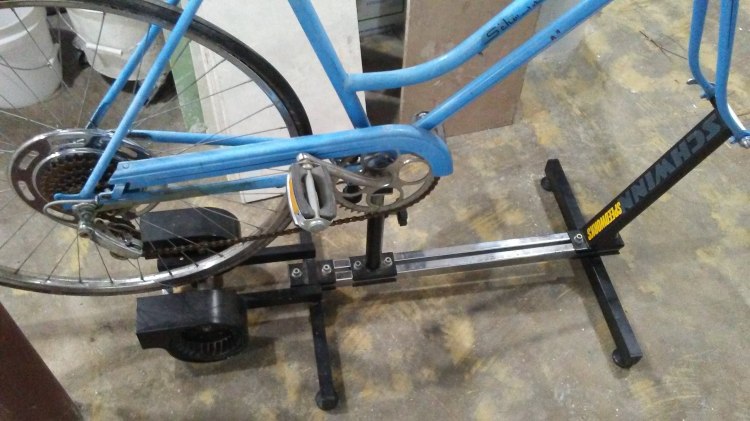
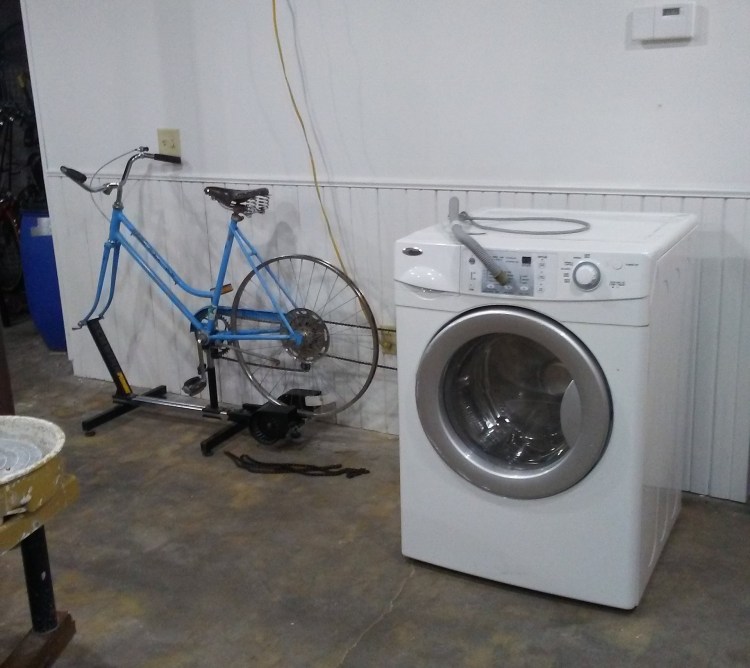
At a thrift store, we found a stand for the bike, the kind people buy to clamp their frames down so they can pedal indoors for exercise. Without getting the laundry done. Ha! What a futile endeavor!

20171231_102123
You could build your own stand, but this one works just fine.

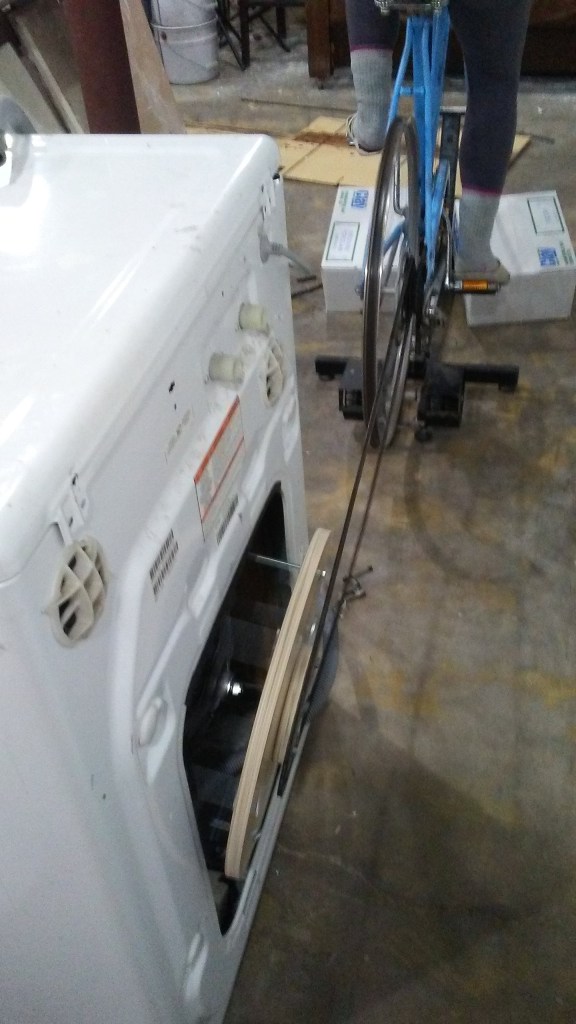
We mounted the bike on the stand and hooked up a very long bike chain to the ring on the back of the washing machine.

img_20180101_082944.jpg

In this first iteration, we left alone the chain going from the pedal crank to the rear wheel, and put on a separate, longer chain to go from the washing machine to one of the gears of the three-speed assembly. We hoped this would allow me to change gears and hence speeds during the washing cycle.

20180113_1249401

This arrangement didn’t work too well. We couldn’t quite figure out how to adjust the bike’s position in relation to that of the washing machine, and kept derailing one or both of the two chains.  It worked fine until you actually added clothes and water to the machine. This is, admittedly, a crucial flaw.

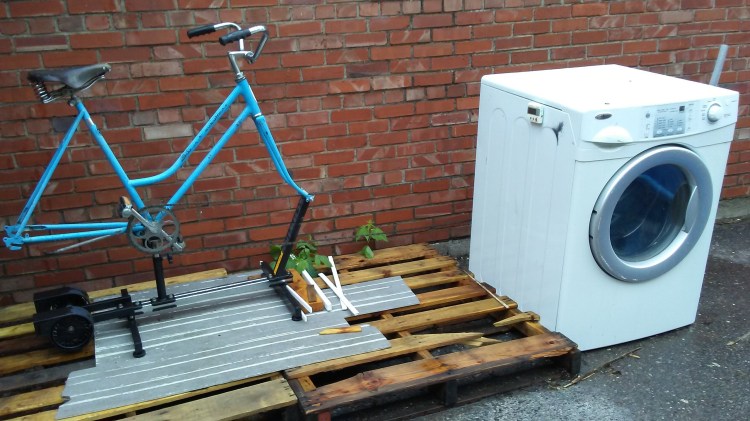
As usually happens, the solution was to simplify the whole assembly. We turned the bike around and ran the chain directly from the pedal crank to the washing machine. While excluding the possibility of a spin cycle, this would allow me to pedal forwards or backwards, which makes me think I’m getting more agitation, and the clothes are getting cleaner. I like thinking that.

20180531_082553

So here’s the current setup. Notice the pallets, which act as bracing to keep the bike from creeping closer to the washing machine. A two-by-four screwed into the pallet holds the bike in the right place, with shims to correct for chain stretch. Too much deviation in the position of the bike will still derail the chain, so I always sight along the length of the chain to make sure it has as straight a path as possible between the two gear rings. Because stopping to put the chain back on gives you greasy, black fingers, which is not helpful while you’re doing laundry. Trust me.

20180531_082616

So here’s how I wash clothes on my pedal-powered washing machine. First, I soak the clothes in a small tub of soapy water for about a half hour. (I’m a firm believer in anything that makes my job easier. If a half hour soak lessens pedaling time by 5 minutes, by all means: soak the clothes.)

20180507_082344
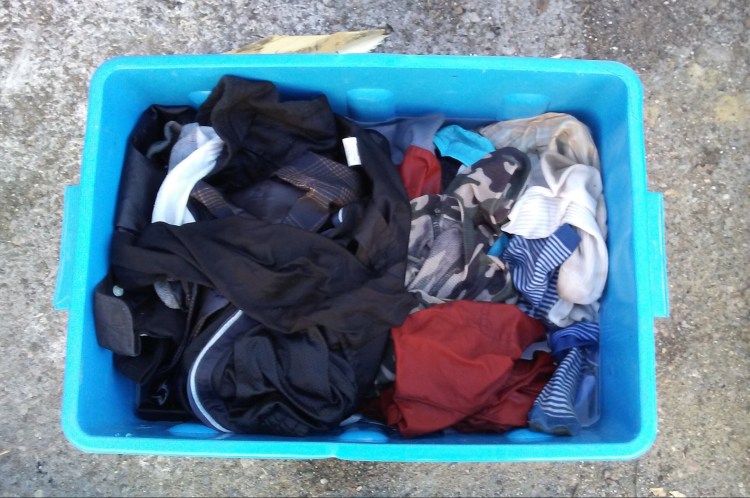
This bucket represents about three days’ worth of laundry for our family of four. Doing one load of wash every three days is really not too bad, even when it’s your legs that are the motor.

After strapping on my biking shoes, I dump the clothes with their soaking water in the front door of the washing machine. Then…

  • I pedal for 10 minutes. At some point I may decide I want sparklingly clean clothes, at which time I’ll pedal for 15 minutes. For now, “cleaner” is good enough for me.
  • Drain the soapy water out by letting the drain hose down onto the ground. When the water is done draining, I lift the hose back up and pour 4 more gallons of fresh water in the front door of the machine.
  • Five more minutes of pedaling.
  • Second drain. I pour this water on the plants, if they need it.
  • I fill a 5 gallon bucket half full of water and prepare for the “final rinse.” By which I mean, as I pull the clothes out of the machine, I drop them by batches into the bucket of water, swirl them around, then wring out each piece by hand.

This last bit is maybe a little less than elegant, but I found that the clothes needed that second rinse, plus my hands were feeling left out after my legs got such a thorough workout.

Average water usage per load: around 13 gallons (rainwater if I can get it). Average energy usage: half a bowl of granola.

Finally, I hang the clothes out in our “solar clothes dryer” and go inside for some lemonade.

20180507_102359.jpg
It was all worth it, when I got to do this…

There’s a quick video of me biking the laundry (the first iteration) on my teeny tiny YouTube channel. (I know. The Luddite has a YouTube channel.) Here’s the link.


Home-Grown Sugar

April, 2018.

I look forward to maple sugaring season like a child looks forward to Christmas. So pardon me if I wax poetical about the mysteries, the vagaries, the brutalities, the unfathomabilities that are the maple syrup season. For me, the significance of maple syrup season is not, in fact, those jars of sticky gold on the shelf.

It’s about the promise that winter will indeed lose its grip on the world and pass the baton to spring. It’s the thought that comes into your head as you go out into the blustery woods to tap the trees (having pulled on your snowshoes and choppers) that at the end of the season when you go out into the woods to pull out the taps (having pulled on your mud-boots and raincoat), you will be hearing the song of the spring peepers, those tiny frogs that sing to greet the coming of spring. It’s about participating fully in the coming of spring, celebrating each small re-appearance–the slow accumulation of different species of birdsong on the air, the snowdrifts yielding to mud, the upward slanting of the sun, the tiny unfurling of each leafbud.

Besides all that, maple syrup is amazing stuff. When we consume it, we’re slurping last year’s sunshine. All last summer, the leaves produced sugar from the energy of the sun. Come fall, as the leaves of the sugar maples turned yellow and orange, they sent the sugar down the trunk and into the roots to be stored during winter. When the trees begin to awaken in the spring, they haul that sugar back up from their roots, along with water and minerals dissolved from the rocks by the toes of the trees. When we drill a hole into the trunk, we’re intercepting a little of that current. The trees don’t seem to mind, but we make sure to thank them anyway.

20180309_135902.jpg
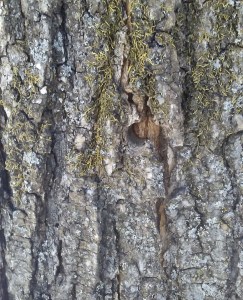
One of last year’s tap-holes, already healed over.

The sap stops running when the trees begin to unfurl their leaves. You pull out the now-dry taps and right about then the woods begin to green up with pale leaves–spring has arrived. You do a whole lot of dishes, listening to the spring peepers through the window as you wash sticky syrup out of buckets and off the counter, then go outside and plant your garden.

But back to winter…

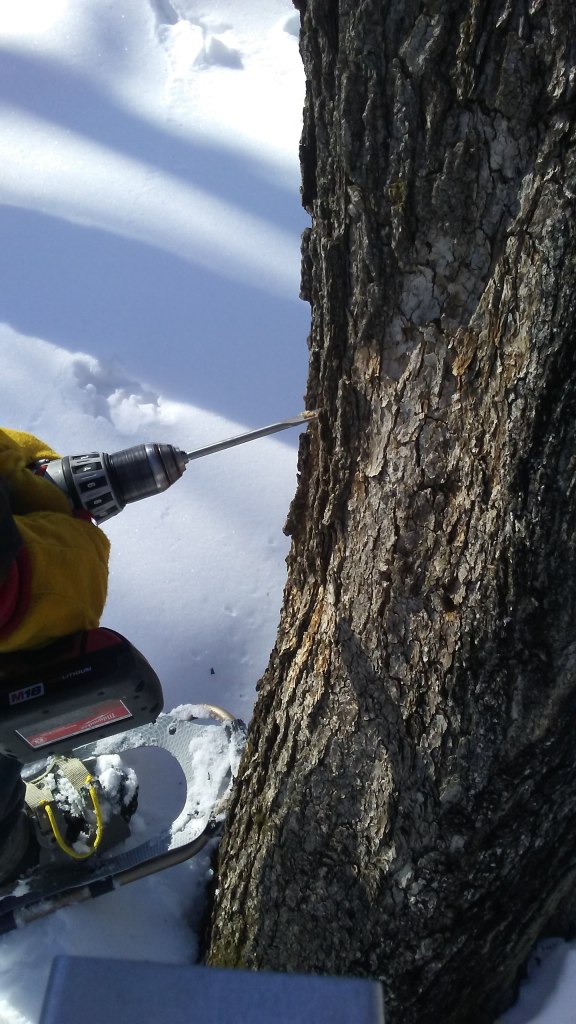
When the days begin to waffle between freezing nights and above-freezing days, we load up a sled with taps, blue sap bags, the drill and rubber hammer, and head out into the woods. J. mans the drill and I tag along behind with the rubber mallet to pound in taps and hang bags. This year we put about 45 taps into 30 trees.

20180309_134418.jpg

20180309_140048.jpg
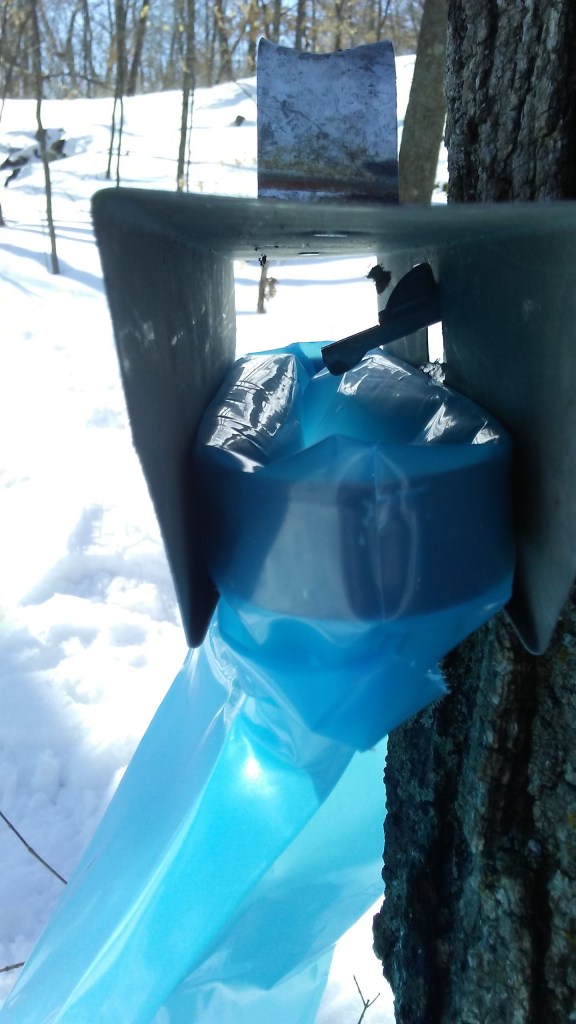
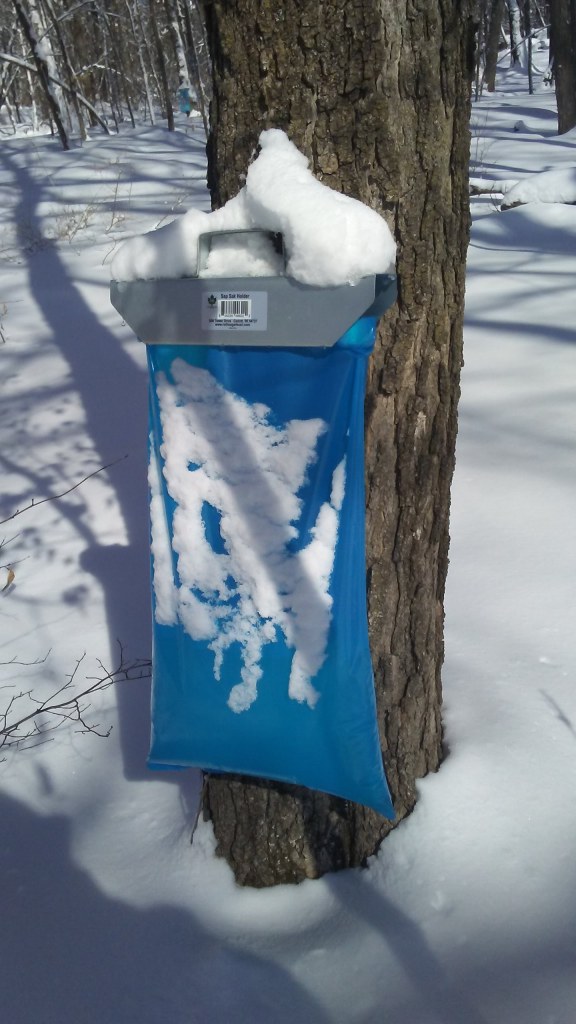
Here’s a closeup of the tap, banged into the tree with the mallet, and the hanger with blue bag blowing in the breeze, waiting for sap to drip.

After the exhilaration of tapping trees and hanging bags, the woods are quiet again, and we wait with baited breath for drop by drop to accumulate into a bagful of sap.

Making maple syrup is about patience, and paying attention to the rhythms of nature. You can’t make the taps drip any faster by prodding them, or make them run if the conditions aren’t right, and you can’t make the sap boil into syrup any quicker. All sorts of factors contribute to how fast the sap runs: temperature of course, but also barometric pressure, wind, direction of slope, moisture in the soil, and soil temperature. Humans make schemes to foil these natural processes all the time, but personally I relish the opportunity to be under Nature’s thumb, reminded of just how small I am, a tiny creature walking the crust of the earth, among giants.

20180309_141928.jpg

20180412_145742.jpg
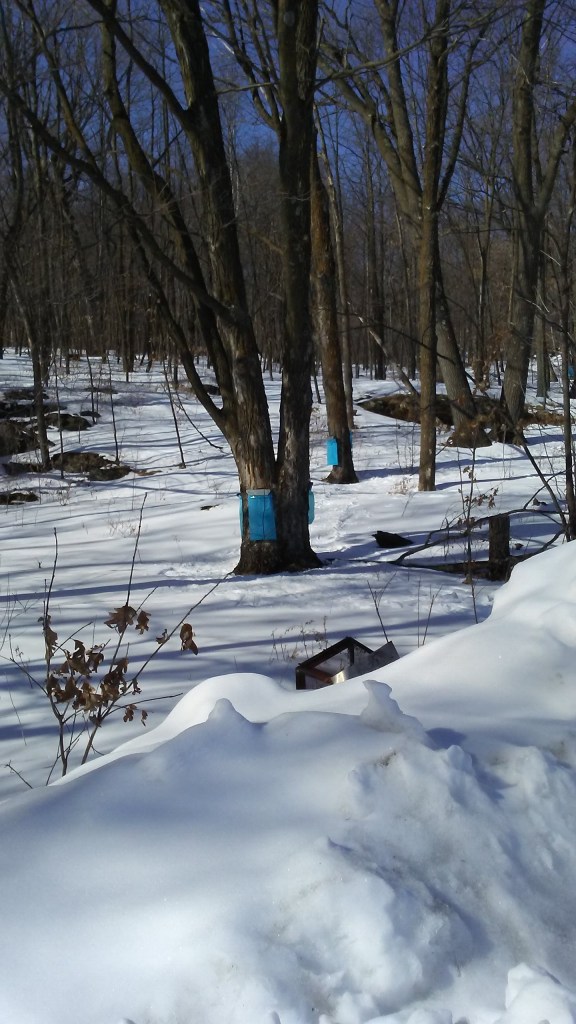
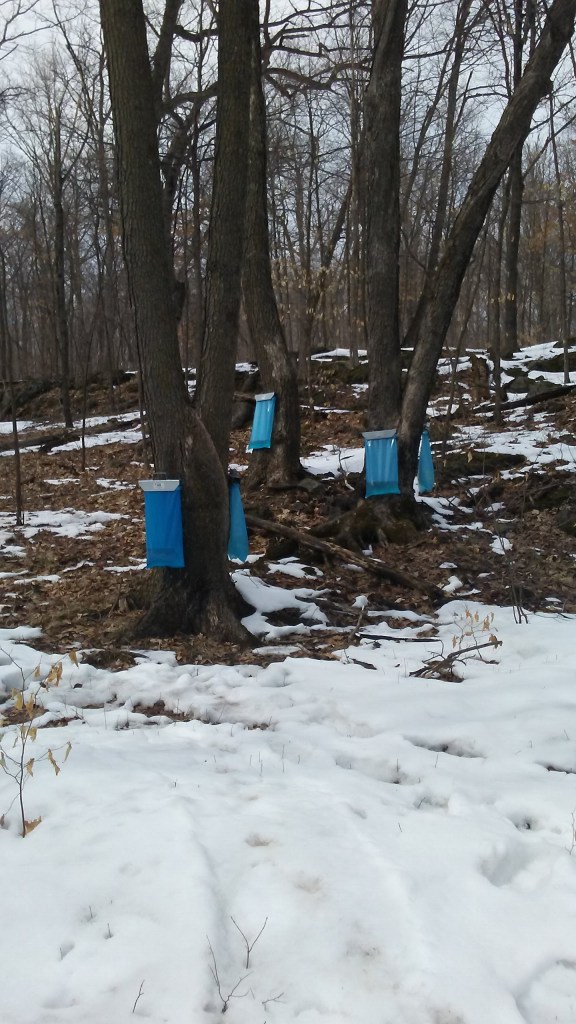
My favorite little neighborhood of trees with their unsightly little blue hangers-on. Shallow soil here on top of a rocky, south-facing slope promotes early warm-up of the soil and thus early runs of sap.

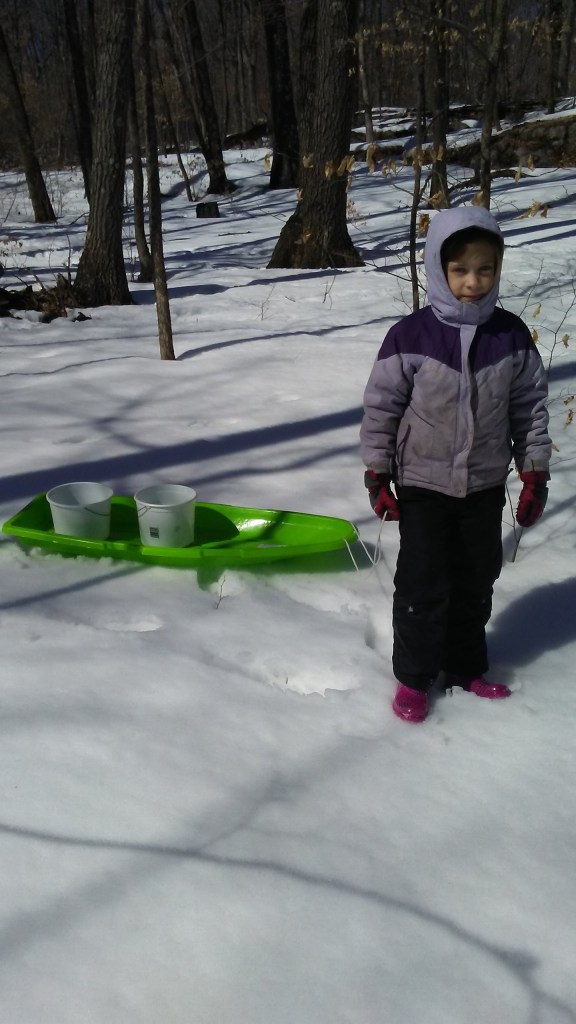
Time to collect sap. Being Luddites, we lug five gallon buckets into the woods, one in each hand, into which we pour the sap from the bags. So far, the highest technology we’ve used in this process is our children’s sled, and even that has its drawbacks, like the tippage factor.

20180317_135937.jpg
Here I have some willing(?) help.
20180412_141448.jpg
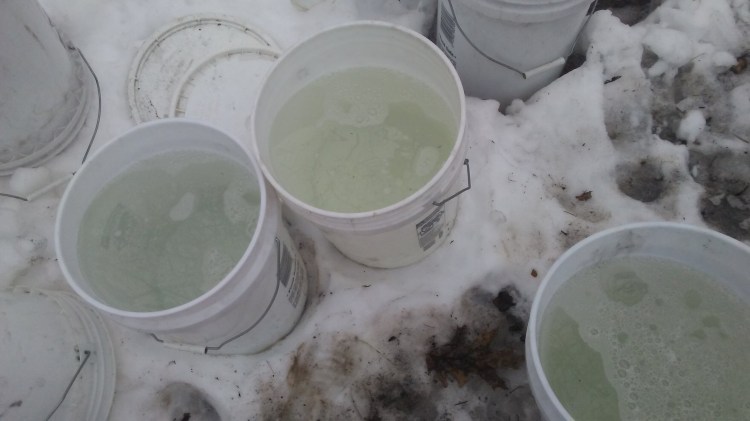
Collected sap, waiting eagerly(?) to be boiled. One of the pleasures of maple sapping is plunging a mug into these buckets of ice cold sap and drinking fresh, tree-filtered water, slightly sweetened. The whole process is almost worth it already.

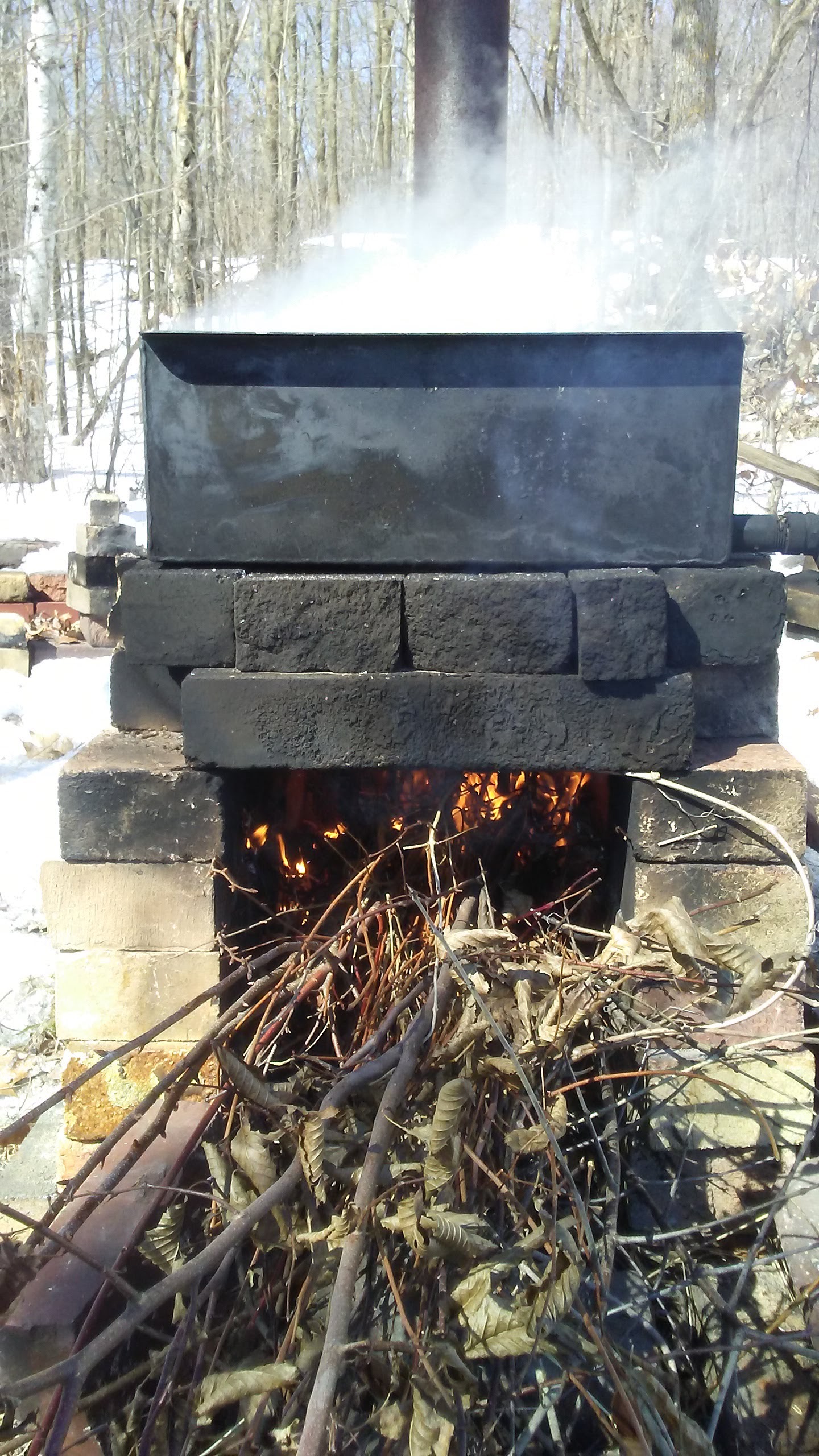
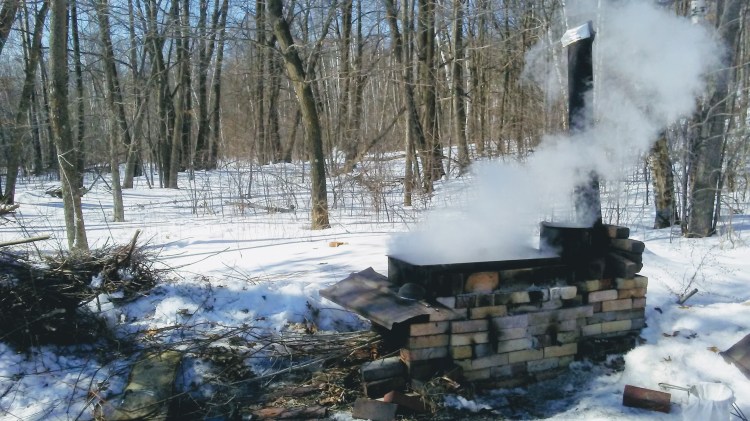
Time to boil! Maple sap is about 2% sugar, so the time devoted to maple sugaring is mostly spent boiling off all that water. Since I’m a potter and potters accumulate firebrick like a rolling snowball collects snow, I have lots of materials for an outdoor sugaring stove, called an “arch.” Ours is a simple coffin-shaped box made of firebrick, with a chimney at one end and a giant (3 foot by 18 inch) stainless steel pan on top.

20180313_115058 (1)
By most maple sugarers’ standards, this is a tiny operation. To which I reply, “Why, thank you. It certainly is.”


On warmer days this winter I’ve been out in the orchard cutting back thickets of brush that have grown back since clearing it three years ago. I piled the trimmings into a gigantic pile near the maple syrup arch so I could have the joy of burning it. It was truly a joy to bundle up armfuls of prickly ash, blackberry, buckthorn, and Virginia creeper, stuffing them into the glowing maw of the arch. Certainly, they did not want to go, and held on to my skin and clothes with every thorn in their beings, but I would not be conquered. I found it so satisfying to burn weeds and get maple syrup out of the deal that I’m almost embarrassed to admit it.

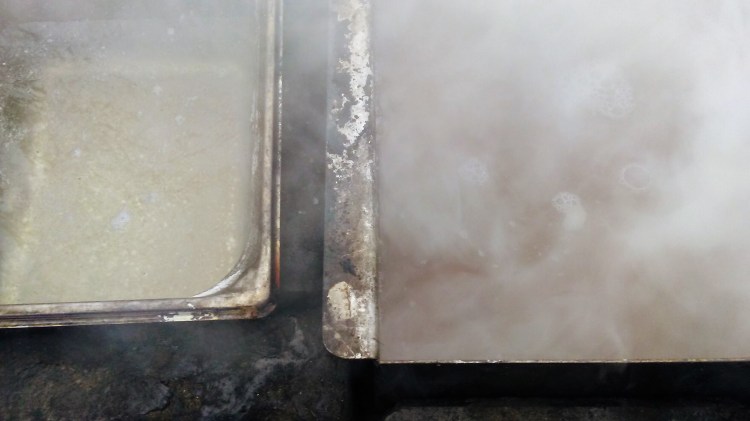
Here, in case you’re interested, is our system for boiling maple syrup. We have two pans on the arch: the one large pan and a smaller warming pan. We load up both pans with sap and start the fire. When the sap has started to boil, evaporating enough liquid to lower the level in the large pan, we pour the sap from the warming pan into the large pan, then fill the warming pan again with cold sap. This way we can keep the sap in the large pan boiling fast.

Now is the time to plunge a french press coffee pot into the boiling sap and make some bracingly sweet coffee. Another heady pleasure of maple syrupping.

20180327_085247 (1)
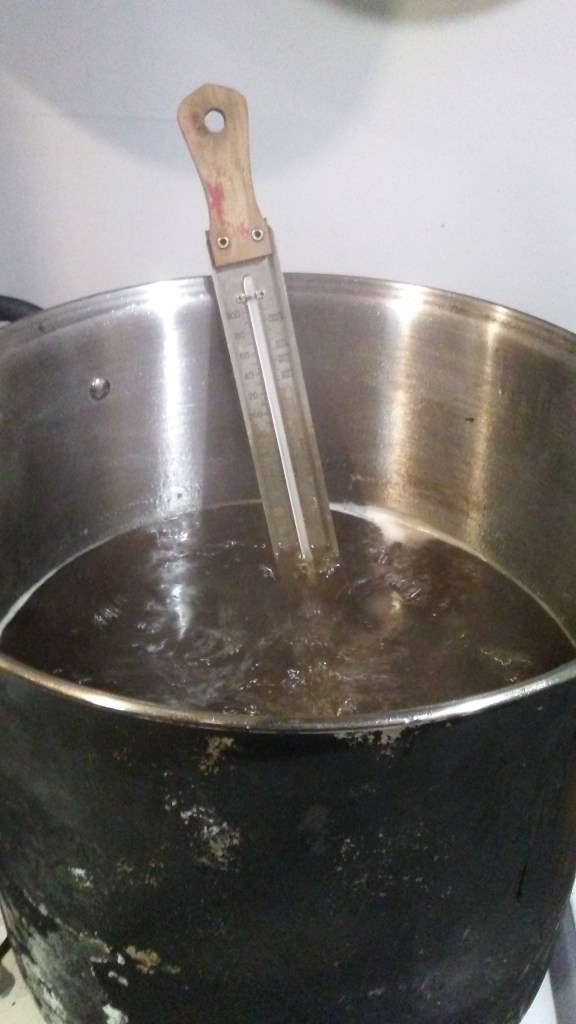
Smaller warming pan on the left, main pan on the right. Notice how clear the sap in the small pan is compared to the darker, farther-along syrup on the right. Too bad you can’t smell this photo. Imagine the scent of sugar on smoke.

At some point we run out of sap to keep pouring into the pans. We keep on pushing in the wood until we run out of nerve, fearing the level of the sap will sink so far that we’ll burn it. So we pour off the syrup (straining it through cheesecloth) into a stockpot and bring it indoors where we can civilize it over a stovetop burner. Now all that has to be done is to heat it to 219 degrees. This always takes way longer than it seems like it should, and the smell of sugar begins to saturate the house, driving me, almost against my will, to make pancakes for supper. Again.

20180410_202532 (1)

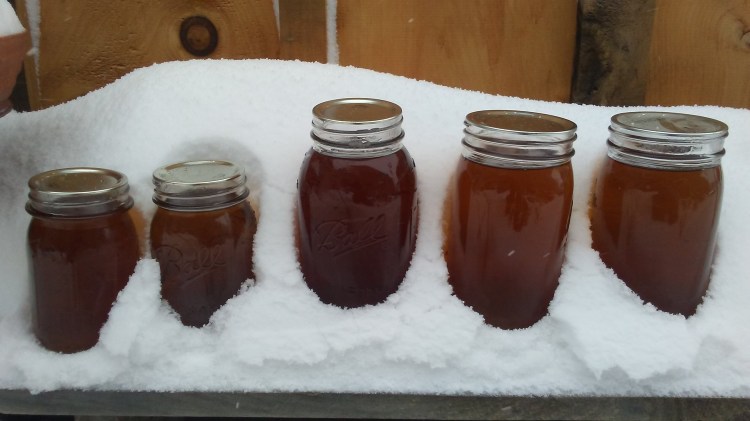
We filter it again on the way to mason jars, screw them shut, and listen for the “ping” as they seal. This year’s count is 15 gallons, stacked in quart and pint jars in our pantry. A few other particulars about this year’s sugar season:

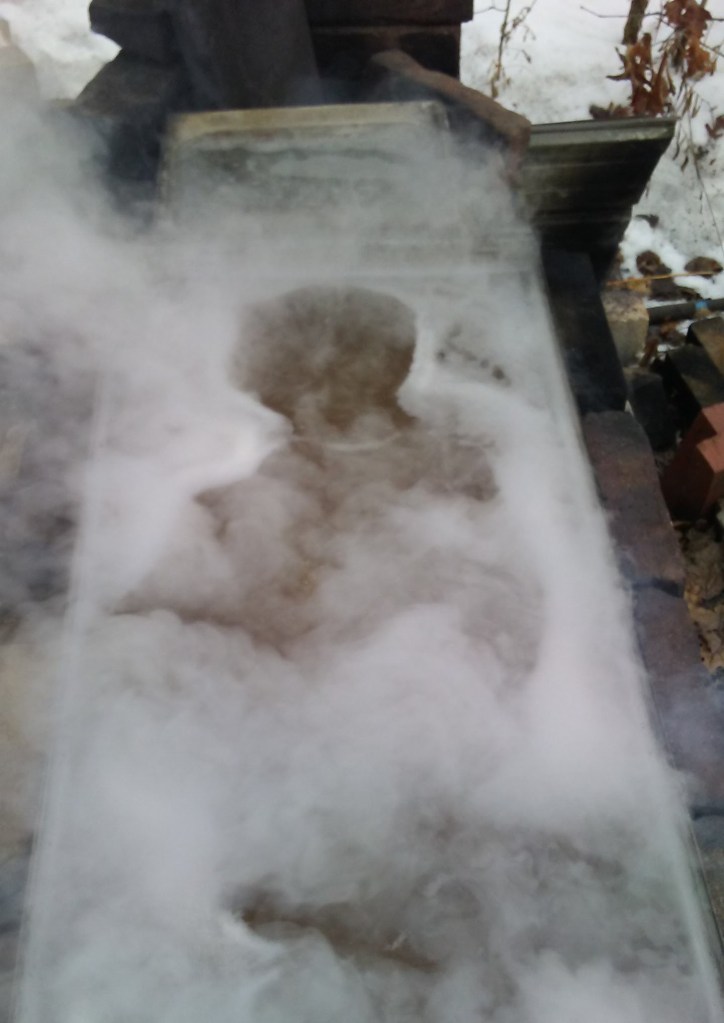
A ghost has been showing up in the foam of the boiling sap:

20180327_101244 (1)
Your caption here.

And then there’s the weather this spring. A couple weeks after the trees started to awaken and the sap started dripping, the temperature plunged again and snow began to fly in earnest. Somehow a week of January had been accidentally grafted into March.

20180404_095550 (1)
You may be able to see the sap half filling this bag, frozen solid, cloudy as a snowy sky.

Spring came again–sort of–enough for the sap to run again. But as I write (let me remind you that by now it’s April) a winter storm is howling outside the window, 8-15 inches of snow in the forecast. After two days of boiling on the outdoor arch, we’ve brought the most recent batch of syrup inside to cook down on the stove. By all accounts, this will be an epic year for maple syrup producers, since winter won’t give up its hold and the trees will linger between asleep and awake for much longer yet.

20180415_122952.jpg
This is what a gallon of home-made syrup looks like in a spring snowstorm. Precious stuff–each quart represents 10 gallons of sap brought out of the woods, and hours of boiling.

But I may just have had enough of making maple syrup for this year.

In other words, it’s April and the buds on the trees are still tightly closed, the frogs are still frozen in the muddy pond bottoms, their spring songs a taunting dream. The garden is under piles of snow and the robins are hopping about, looking hungry.

I believe I too am ready for spring.


Earthen thoughts at Lent

This Lent season our thoughtful new pastor challenged us to think of some of Jesus’ “I am” statements in the Gospel of John and write responses to be read aloud at weekly evening services. Always one to love an assignment, I dug in. These concrete sayings of Jesus began to feel like they were meant for people like me, who work with our hands in the dirt, who don’t sit around ivied halls thinking about theology. They give us something to sink our teeth into as we contemplate the passion of Christ.

So if you, like me, think with your body (and, if necessary, your brain also), have a chew on some of these, and a Happy Easter to you.

***

“I am the Light of the World.”

It’s hard to remember now in the dark quiet of this Lenten service, but this week, under sunny skies and all this new snow, you might have found yourself like me, squinting against brilliant sunlight reflecting off white snow. It’s reminded me of a condition I’ve read about called snow-blindness. Also called photokeratitis, it’s essentially sunburn of the eyeball, caused by UV rays reflecting off snow and ice onto the unprotected eye, usually at high altitudes where the atmosphere is thinner and the light less diffuse. Apparently you go home after a day on the ice and in a few hours your eyes begin to swell, tear, and blur; they’ll feel gritty beneath the lids, and you may lose your vision temporarily. (I don’t recommend Googling images of this condition.)

The Inuit people of Alaska, for whom this injury is a real and present danger, have a way of preventing it. They craft slatted blindfolds, traditionally carved from bone or caribou antler, sometimes elegantly carved, but, in a pinch, fashioned from birch bark. Pin-the-tail-on-the-donkey style, they completely cover the eyes except for one horizontal slot on each side, allowing just enough light to enter the eye to find one’s way hunting on ice and snow, but not enough for the light to burn the eyeballs.

When Moses came down from the mountain, where he received the law from God, the people of Israel were afraid to look at him, his face glowing with the after-glory of God. He made a veil for himself, so he could go among the people without them fearing his God-flushed face. Did his eyes swell? Did they turn bloodshot and feel, blinking, as if he had sand in his eyelids?


Why would Jesus liken himself to something so ruthless, so unrelenting, so damaging as light? Why not compare himself to raindrops on roses, or whiskers on kittens? Didn’t he remember that we’re only humans, with fragile, burning skins and eyes that blur and grit when God passes by; when, even from the cleft of a rock, covered by God’s hand, we catch a bare glimpse of his back?

How are we to deal with this relentless, unsparing glory of God? Should we fashion blindfolds, and go about our lives feeling about with our hands, wearing long sleeves to protect our friable skin? Or do we climb a snowy hill, strip down and lie naked in the scouring light, exposing all our dark, protected places, eyes wide open?

***

“I am the Bread of Life.”

Are you looking to add more carbs to your diet?

You should try my recipe. It’s a simple one, using perhaps the oldest method of bread baking known to humans, developed before there were baking pans, before you could buy bagged Gold Medal flour in the grocery store; shoot, this is even before people knew gold was a metal.

So this recipe will get you those missing carbs, help you to get in touch with your ancestors, and it’ll get you outdoors and connected to nature!

First, go outside and collect some wild grains. Weeds often make great grains, so keep your eye out for tall weeds forgotten on the edges of fields. Gather an armful, dry them, and grind them into flour. Mix your flour with enough water to make a dough, and add some salt if you have it. Pat it into thin cakes.

Stir up last night’s bonfire until you find the coals at the bottom. You’ll recognize the hottest coals because they’re covered with white, not grey ash. Lay one of your cakes on the hottest ashes and cover them with more hot coals and ash.

Wait.

Disinter your bread from where it’s hidden in a pile of ashes. You’ll know it’s done when it’s black and blistered in places. Don’t worry if it doesn’t look perfect. In fact, this sort of bread is often ugly, misshapen, even difficult to recognize as bread.

Use a brush made of fresh grape leaves to brush away the ash and cinders. Be careful not to burn yourself as you pry burning cinders encrusted in the surface. However, remember that a little ash is good for the digestion, so if you consume a little grit with the crust, don’t worry.

Break open the loaf and eat it with the heat of the fire still inside. It will taste wild. Those rangey, misunderstood weeds from which it was made will nourish your body with nutrients it didn’t even know it was lacking.

Remember, this is an ancient bread. It has none of the leavening agents, sweeteners, or fats that make our modern bread so soft, spongy, and delicious. In fact, because it’s so tough to chew, and with the occasional cinder, more than one person has broken a tooth on this bread.

Hopefully you have strong teeth.

Or, now that I think about it, maybe it’s better if you just go ahead and break a few teeth against it.

***

“I am the Good Shepherd.”

So I’ve been thinking about this passage all week, and it reminded me that the Easter season is also lambing season. But I have to admit that while I’ve been thinking about Jesus being the good shepherd, I’ve also been getting our maple syrupping equipment together to tap our trees, and now maple syruping season is all confused in my head with lambing season. Maybe because both imply a reliance on french press coffee, fleece vests, and mud boots. Both are yearly rituals that foretell the coming of spring, while summer still feels quite far away. Both involve a bit of anxiety, a vulnerable eye to the weather, and end with exhilaration as one counts one’s jars, or lambs.

As I make my rounds among the trees emptying the taps, I feel a little bit like a shepherd, only with very widely spaced and stationary sheep. I’m not ashamed to admit that I can be heard whispering encouragement to my barky charges–as I empty each bucket, we commune, mitten to bark, and I give them each a fond pat on the flank before going on to the next tree. My boots wear muddy paths between them.

This is about as close to shepherding as I will ever get. With apologies to the farmers and husbandman here, I don’t identify much with sheep. Somehow looking into those ovine faces, their weird horizontal pupils put me off my feed a little. And maybe I find it just the teeniest bit offensive that Jesus would compare us, God’s highest creation, to sheep, with their…encrusted hindquarters and their dumb instinct to follow whatever moves. I would much rather be compared to a sugar maple tree, all graceful limbs and a preference for dancing in the summer breeze.

But Jesus was surrounded with sheep his entire life. Some of his first visitors were probably sheep, jostling him to get at the hay in the manger beneath his little swaddled self. John the Baptist greets him at the beginning of his ministry by calling him the Lamb of God. Now here he is, calling himself the Good Shepherd, the true shepherd, this claim that puts him on the level of God, and it’ll get him killed. Maybe he should have called himself the Good Maple Syrupper… it might have saved his life because no one would have known what he was talking about.

These trees I tap, they live in the forest all their lives. They reach up their twiggy arms to the sun, send their roots down deep and suck water and minerals from the juice of rocks. They stand and sway all year around, and wear their fall colors quietly. They are exactly as they were created to be.

And the sheep, they live in their fleeces all their lives, bearing those burry, muddy skins with no thought either of embarrassment or pride. They do not spray with lavender water or attempt to not follow whatever rump happens to be before their noses. They eat their hay with relish and tolerate the lambs that skip in the fields. They are…sheep, no more no less.

So why am I surprised every year to be marked with ash and reminded that I am made of dust, and to dust I will return? Why do I persist in denying my own encrusted hindquarters? That dust, that humus, that makes me human, it feeds the maple trees. The prophet reminds us that “all flesh is grass”: the same grass that is eaten by sheep.

Jesus, as he approaches his own death, in his gentle way reminds us who we are. It says “He was moved with compassion for the crowd, because they were harassed and scattered, like sheep having no shepherd.” Like he did for that crowd, he also gathers us to himself, he heals us, he feeds us. He knows us, who we are at our core: animate clods of earth.

And he is not dissuaded. He chooses to go alongside us, participating with us in the very actions of our lives, not just the swaying midsummer dances, but the eating of our hay, and the cleaning up afterwards. He simply wants to be with us. Even when we go to the laundromat to cleanse our clothes from the smell of our bodies, and he knows we will stink them up again next week. He goes with us, and not to spray lavender water over our humusy bodies. He breathes in deeply the scent of the ones he loves. And we, with our laundry basket at our hip, are sanctified by the presence of our shepherd, who walks alongside us, wearing muddy paths beside our own.

***

“I am the true vine.”

Grapevines have sole possession of the genus Vitis, which comes from the same root word as vitality, or vital organs: vitalis, “of or belonging to life.” Vitis, the vine of life.

Perhaps you’ve noticed this before: the juice of the purple grape looks a lot like blood, that vital fluid. When it’s moving within your body, you know you’re alive; lose too much of it and you may die.

In the past–Jesus’ day, for example–when the cleanliness or safety of water was in doubt, the best replacement for vital hydration was wine.

So a grapevine, especially for Jesus’ hearers, was the picture of life; of survival, yes, but fertility as well. Even today the sheer weight of a healthy grapevine is known to overwhelm trellises, but given enough structure its mass can be trained to gracefully cover an arbor, shading a patio, turning the light below a cool, filtered green, its fruit weighing heavy on the vine, purple chandeliers to grace the picnic table.

Jesus paints a picture of a branch belonging to a vine, the passive recipient of moisture and nutrients, the bearing of fruit an inevitable off-shoot of its connection to the vine. Thus we, as branches, must simply cling to himself, and he will bear fruit through us. We have simply to abide. To sink our fingers deep and live in him.

Jesus uses a contrasting agricultural picture a couple chapters previous to this, that of seeds. “Unless a kernel of wheat falls to the ground and dies, it remains only a single seed. But if it dies, it produces many seeds.” This is the very picture of death: bare soil; dry, brittle seed interred beneath. Give it a few days and you will see the new shoots of green life, which produce fruit, someday more seeds.

So which is it? To produce fruit, are we to be about the business of dying, or of abiding?


This liturgical year I’ve found myself thinking about the effect of our seasons on the way we interpret the great feasts. In advent, when days are at their darkest, a Light shines forth. At Easter, spring is coming and we buy baby chicks at the hardware store to celebrate new life. But this is the Northern Hemisphere. How must the church on the other side of the world, the Southern Hemisphere, interpret the feasts? At Christmastime, summer is at its height; you luxuriate in the embarrassment of lushness that is the summer solstice and out of all that bounty, Christ is born. At Easter, the lambs are not being born. Instead, farmers are making plans to bring their lambs to market. Easter is a time of growing darkness, and impending death.

So which is it? Are we in the business of new life, or the slaughterhouse? This is the question of Holy Week itself: which is the greater miracle, that Christ, that deathless God-made-man, chose a suffering death for our sake? Or that he quitted it, by rising again from the tomb to a life eternal? Death or life?

I want it to be both. To sink my fingers deep in the bosom of Jesus and brim over with rank, tendrily growth. To burn those over-grown branches and send up sweet smoke. To break beneath the weight of the fruit that I bear, and crush the berries till the ground runs red. Bury me beneath the bare ground, plant an apple tree above me, and make a pie.

***

I’d like to thank Debbie Blue, Russell Rathbun, and the folks at House of Mercy in St. Paul, that lovely incubator for ideas, theology, and art–rich soil from which some of these essays have grown.

Packing it in for the Winter

December, 2017

I took a walk in the woods yesterday. The snow is ankle deep now and fluffy, the air cold enough to flush the cheeks but not cold enough to send me inside for cocoa. I followed deer trails and found the place three of them had slept last night–these were the ones who visited us last summer while we worked on the house. Glad to see they survived hunting season. On my walk I stepped over mouse trails, trying to not disturb them, those exquisite tiny footprints with a tail dragging behind like a watercolor brush.

The heavy quiet of winter has come in full force, the kind of quiet that allows the sound of snowflakes falling to seem loud. Our summer and fall of frantic work is over; it’s time to pay attention to other things and rest a bit before taking up the work again in the spring.

We did, however, accomplish a few jobs before our mandatory retirement time set in. I’ll take some time for a little update.

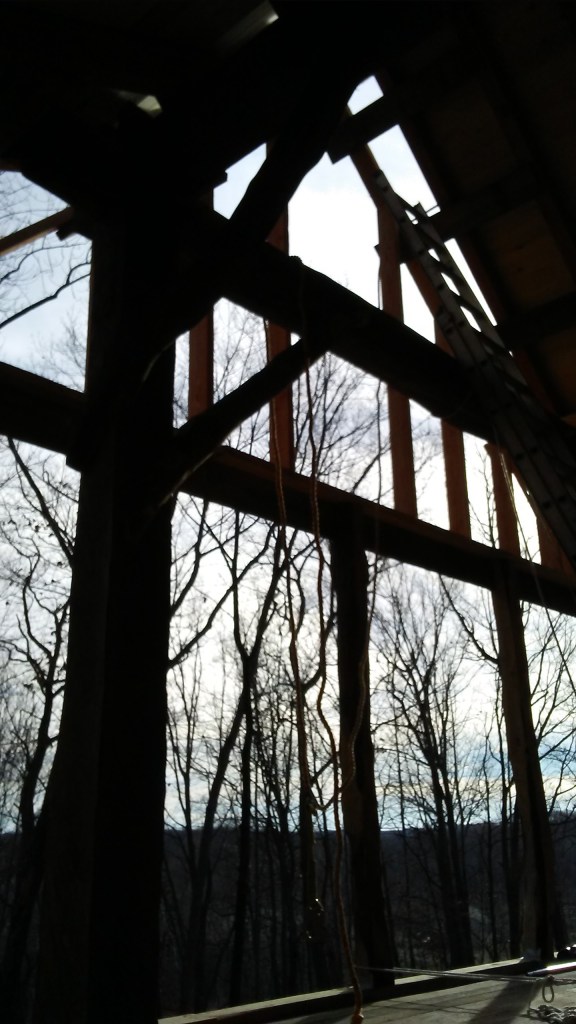
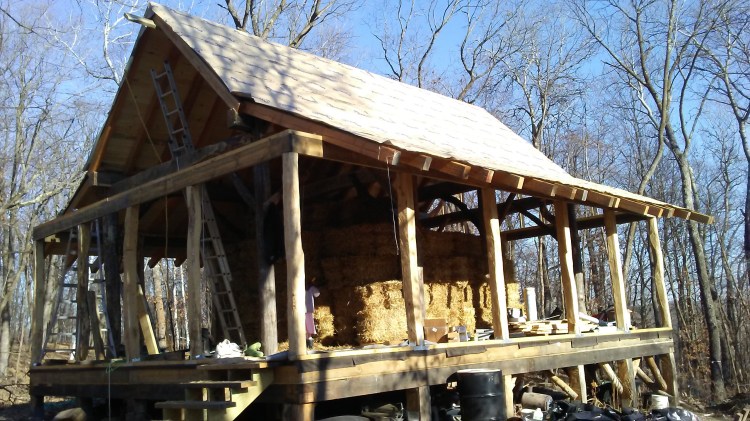
Now that the roof is built, the north and south sides of the house are well protected from the elements by its three-foot overhang. J. turned his sights to the east and west ends of the house, the gable ends, which leave quite a bit of the house exposed. He began pounding up an extension of the gable ends of the roof, which will allow the it to extend past the exterior walls of the house and keep them as dry as possible. It’s exciting to now have a stud wall up on the lofted ends of the house.

20171127_103755.jpg

20171127_103812.jpg
The view from inside. 

I mentioned in my last post that we got the walls of our house delivered a few weeks ago. They were grown in a local field by a farmer who drove them, swaying on the back of his ancient farm truck, up our hill path. I’m speaking, of course, of straw bales. We bought 200 of them to store for spring, when we’ll stack them, Lego-style, as the walls of our home.

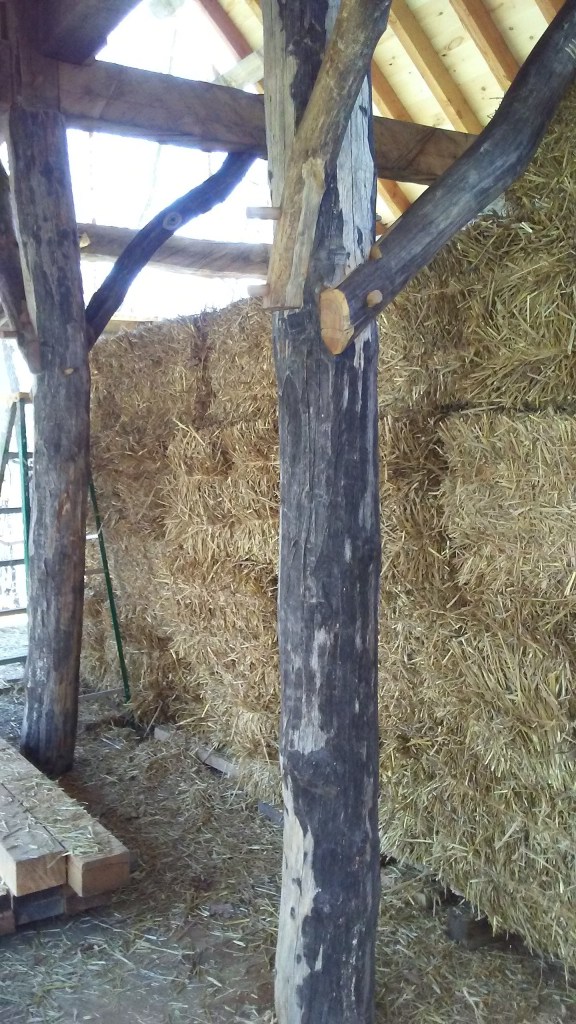
To keep them dry over the winter, we piled them inside the house, liberally sprinkled with moth balls to discourage the presence of those exquisite little mice…

20171202_121729.jpg

20171202_121825.jpg
The effect is decidedly creche-like. Happy Christmas, everyone.

20171202_121949.jpg

20171202_122327.jpg
200 bales of straw take up a lot of room. They did, however, allow a brilliant photo-op. The children clambered up to the top of the pile and, perched on the bales, occupied for the first time  the space that will be their bedrooms.

Straw bales stacked high, it became a much more urgent task to make the house weather-proof. J. spent some time on a ladder in the after-work darkness nailing up tarps, and I came the next day as rain and snow fell, to finish the job. It felt a bit like dressing a super-model in sweat pants and moon boots.

20171204_111354.jpg
Our poor, beautiful house again having to suffer the indignity of tarps. 

Yesterday on my walk through the woods I stopped at our house and peeked in through the tarps to check that all was well inside. Thanks to all the work we’ve done this fall, we have a flying chance of spending next winter tucked inside this beautiful space among the snow-covered trees. I lingered inside, breathing in the scent of straw and wood, not wanting to leave.

A gentle wind blew against the tarps, pulling them in and out as if the house were breathing, slowly, in slumber. Rest well this winter, little house.

Firing the Bourry Box Kiln

December 1, 2017

A tiny reprieve in the weather has allowed me to get one more firing in before the deep-freeze of winter sets in. I thought I’d let you tag along for a firing and peek over my shoulder to get a glimpse of the glamorous life of an artist.

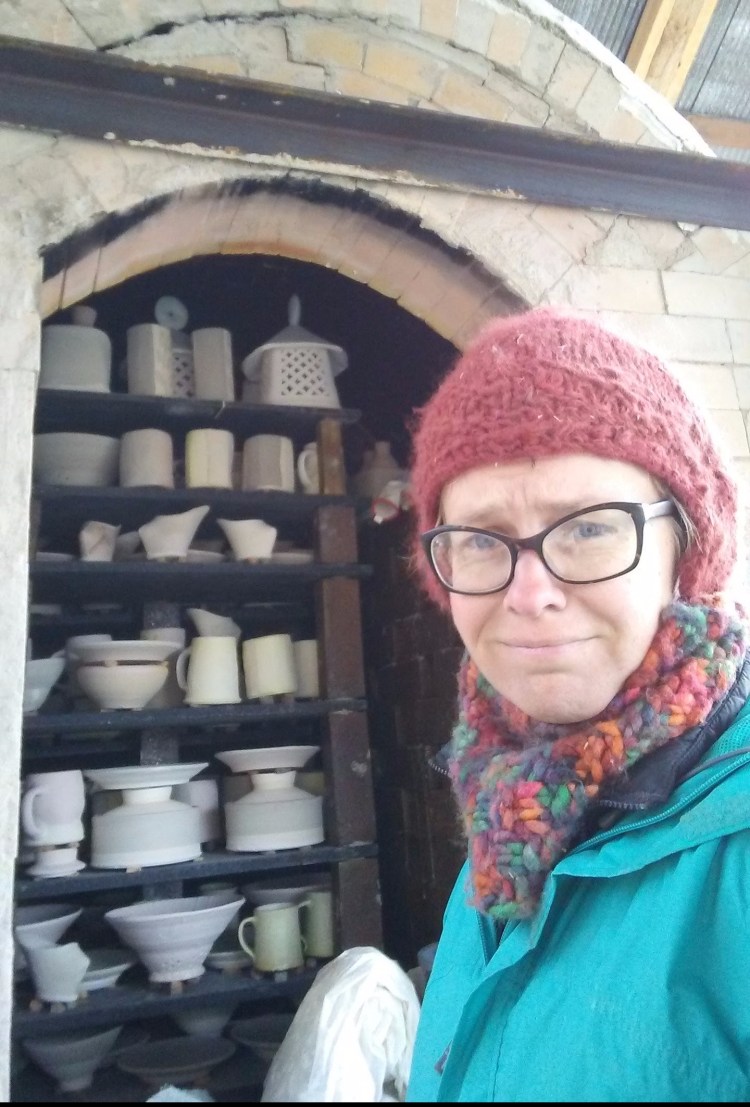
I glaze all my pots at the studio in town and wrap them carefully for the two mile drive out to the kiln. Loading the kiln is not a job I particularly enjoy, so I prefer to chip away at it gradually, working afternoons for three or for days until it’s done. On this particular day, the windchill was a little less than comfortable, hence the frozen and distraught face:

20171120_111826.jpg

Once the kiln is loaded, I brick up the opening with two layers of brick, on the interior a dense firebrick and on the exterior a layer of insulating brick. Usually I slop over the bricked-up door a liquid mixture of sand and clay to block up any cracks, but this time I forgot, probably because of cold fingers.

20171120_145656.jpg

On the picture above, you can see the two arches that cover the kiln. The large one in the center covers the ware chamber, where the pots are. On the left is the firebox, or bourry box, where the fire will be. In a bourry box kiln like this, we stoke the wood in the firebox, and the flame from the wood snakes through an impossibly long journey: from the grate in the firebox it burns downwards toward an arch-covered inlet between the firebox and the ware chamber, is directed upward to the top of the arch in the ware chamber, filters down through the pots, through the flue at the bottom of the ware chamber, and up the chimney (on right). Yes. It’s a long trip, but as you’ll see the wood flame is a long flame and is always up for the journey.

(Note: Now I’m going to document the log of a typical firing, and you might find it a little, well, boring. Slightly technical. It’s ok. You can scroll through and enjoy the pictures and still get credit for reading the entire thing. I’m including this mostly for the benefit of other wood-firing potters, or those who want to be. Who knows, that could be you!)

The firing begins the evening before, when I start a little fire on the floor of the firebox. I feed it with bits of pine for about 15 minutes, then drop in several armloads of chunks of hardwood and close up the hearth door and the chimney damper to allow it to burn slowly overnight.

By the next morning, even if it’s not still burning, the smoldering fire has taken the chill off the bricks and will allow the temperature to rise quickly.

6:00 am: 200 degrees. Fire is relit on the floor of the firebox.

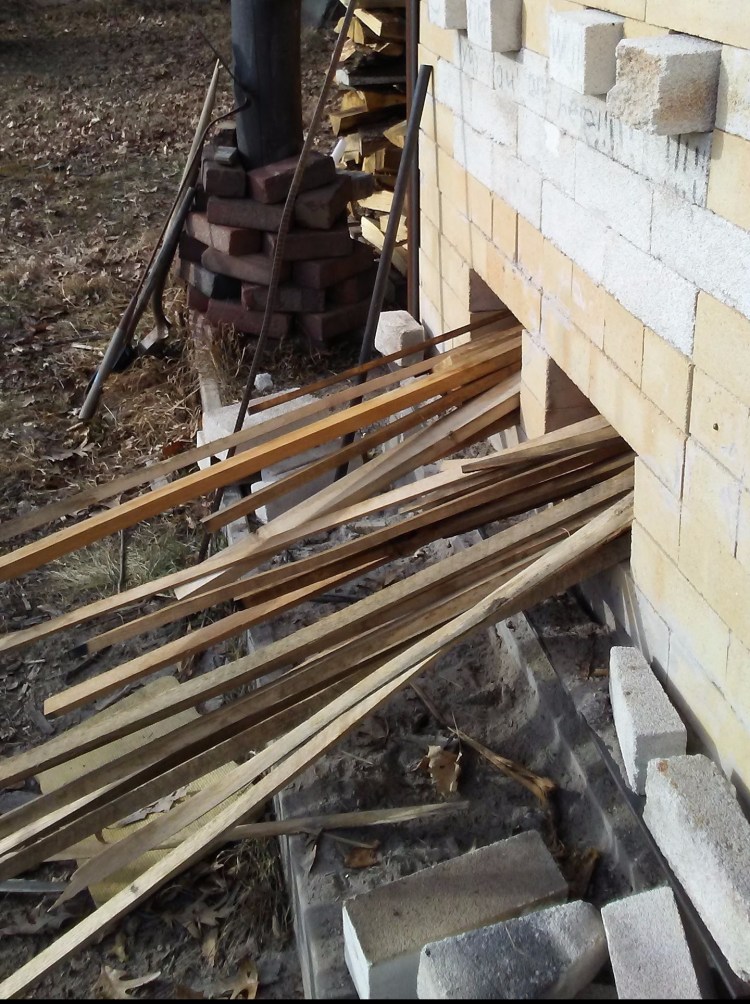
8:30: 915 degrees. Feeding stove-wood on the firebox floor. Jamming in as much as I can–this is tricky because the hearth openings are pretty small.

20171201_084029.jpg

10:00: 1114 degrees. Starting to feed in long hardwood sticks on one side of the hearth door. These can rocket up the temperature quickly so I start small.

20171201_094435.jpg

11:00: 1223 degrees. Feeding in the sticks on both sides. They burn so fast that pushing them in is a nearly constant job. You sit between the piles and push in the sticks on your left, push in the sticks on your right, rub your nose and sigh a little, and then the sticks on the left need to be pushed in again. It’s a bit demanding, but the wood is free scrap from a millwork place nearby, and I’d prefer this to hours with a chainsaw cutting our own. And they work mighty fine for raising the temperature quickly.

20171201_104144.jpg

11:39: 1400 degrees. At this point the coal bed on the floor of the firebox is high enough that it can sustain what we call “moving to the hobs.” The hobs are a grate over the middle of the firebox onto which we will be stoking wood for the rest of the firing. The coals burning on the floor will ignite the wood on the hobs and together the burning wood and the gasses from the coals will allow the temperature to rise even more.

Here’s how we move to the hobs: I stoke one last time on the firebox floor, then stoke for the first time on the hobs. I open the primary air intake and then brick up the hearth door. On this particular day, the wind is a pretty steady cross breeze, so I open the secondary air holes partway and shield them from the wind with a diagonally-cut brick. This amount of air intake allows for a steady, but not too quick rise in temperature.

20171201_160511.jpg
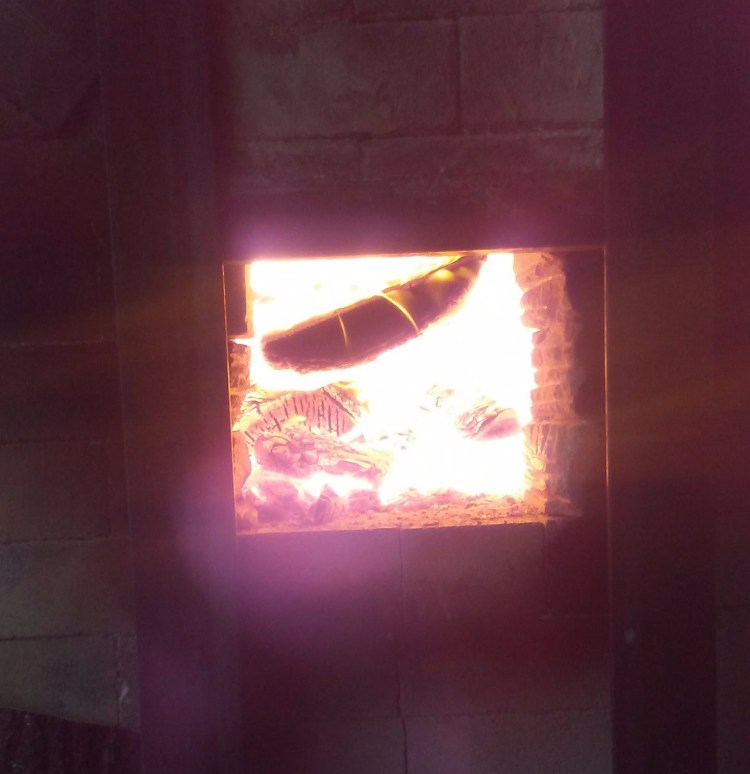
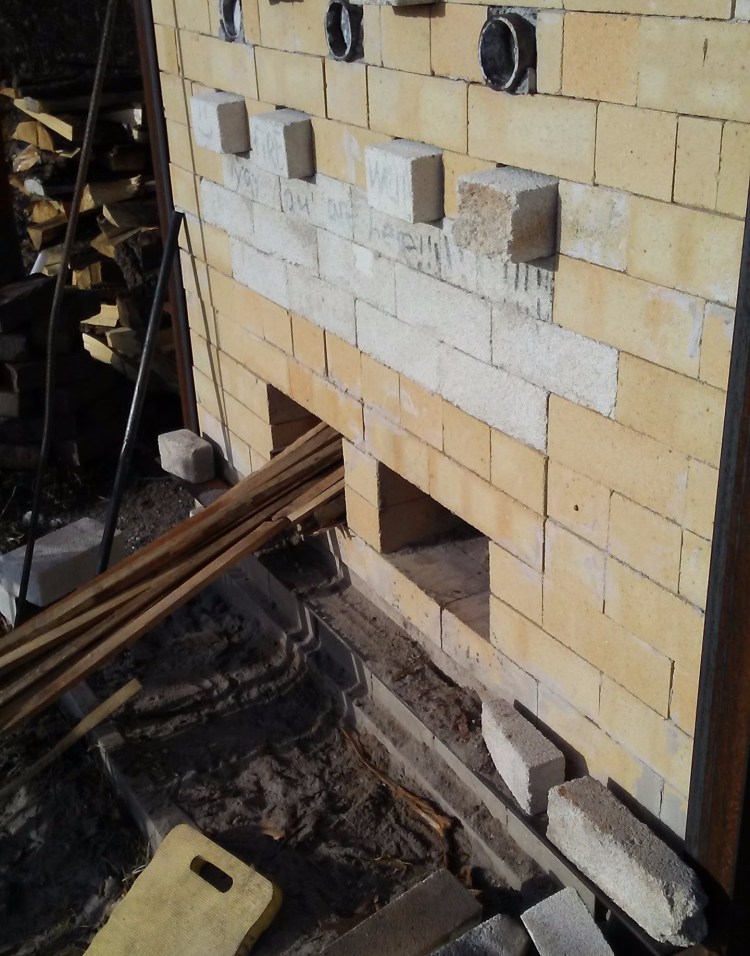
The stoke-door for the hob-wood is on the right of the picture, the counterweights for easing the opening of the door are those odd dangling things. Here you can see the top air holes (primary air) open and the second tier (secondary air) which later in the firing I open all the way. The three circles below that are the ends of the steel tubes running through the firebox that act as the hobs, or grating. And the third layer of openings are peep-holes for viewing the level of the ember-pile.

12:00 pm: 1594 degrees. The wind is making the kiln a little rabbitty. When the wind blows, the temp rockets up, then plummets as the wind drops. But on average, the temp is still rising, about 200 degrees an hour, which is what we’re shooting for.

1:00: 1876. Every stoke I’m stuffing in as much wood as I can onto the hobs, and then I keep an eye on the primary air-holes–when I can see through them that the wood level has dropped, it’s time to stoke again.

20171201_160607.jpg
A view of the wood on the hobs. If this were the smell-ernet, you’d be smelling wood-smoke and my burning leather gloves.

2:00: 2067 degrees. The wind has died, so I open up the secondary air holes. With the increase in heat, the kiln needs more air anyway.

3:00: 2230 degrees. Sometimes I have to insert a pipe through the secondary air holes to poke the wood a little, getting it to drop onto the ember pile and giving more room to stoke on the hobs. The tricky thing with firing a bourry box kiln is maintaining a proper level of coals on the floor of the firebox. Let it burn too low and the fire on the hobs gets sluggish. Let too much wood fall onto the ember pile and the arch between the firebox and the ware chamber (aka “throat arch”) gets clogged with embers. So keeping the wood on the hobs is a good thing, but poking it down occasionally does rocket the temperature up. I can check the level of the ember pile by opening one of the lower peep-hole bricks.

20171201_160500.jpg
Here’s the evidence that the wood-flame can travel. That is a 30 foot chimney out of which it is shooting, from its origins in the firebox. Right about now, people driving by on the road in front of the kiln begin to slow way down.

3:15: 2300 degrees. My thermocouple begins to melt at 2300, so I have to pull it out. From now on, I read temperature through a set of pyrometric cones which I’ve set in the kiln. Each one melts at a different temp, so when one has melted and another hasn’t, I can tell the kiln is somewhere between the two cones, say, 2300 and 2320 degrees. For all you potters out there, I’ll admit that somewhat randomly I’ve chosen cones 5, 8, and 10.

3:45: I have two spots in the kiln where I’ve set cones, one near the top of the setting, one near the bottom. Cone 8 is down on the bottom, half down on top.

4:30: Cone 10 bending on the bottom and on the top it’s softening. I stop stoking. I putter around, picking up and putting things away, waiting for the wood on the hobs to burn all the way down. This takes about a half hour, and by that time cone 10 is all the way down on the bottom and nicely bent on the top. I close up the air-intake holes, close the damper on the chimney, and burn rubber on the way home.

As an end note, I would like to say proudly that I did nearly all of this firing by myself, with only an hour or two of help from J., my faithful side-kick. He was only busy UNLOADING THE STRAW BALES THAT WILL BE THE WALLS OF OUR HOUSE. While I was firing, a local farmer brought by 200 bales of straw in four trips with his dangerously overloaded antique farm truck. I’m so sad to say I didn’t get a picture for you (he was quite picturesque) because I was busy stoking wood.

And a final end note, a hearty thanks to Linda Christianson, a potter just across the river in Minnesota, who helped me figure out this whole wood-firing process. Last time, after two previous failed attempts, she midwifed my firing via phone call and gave me the hope and confidence I needed to attempt it again. I’m so grateful for her generous tutelage.

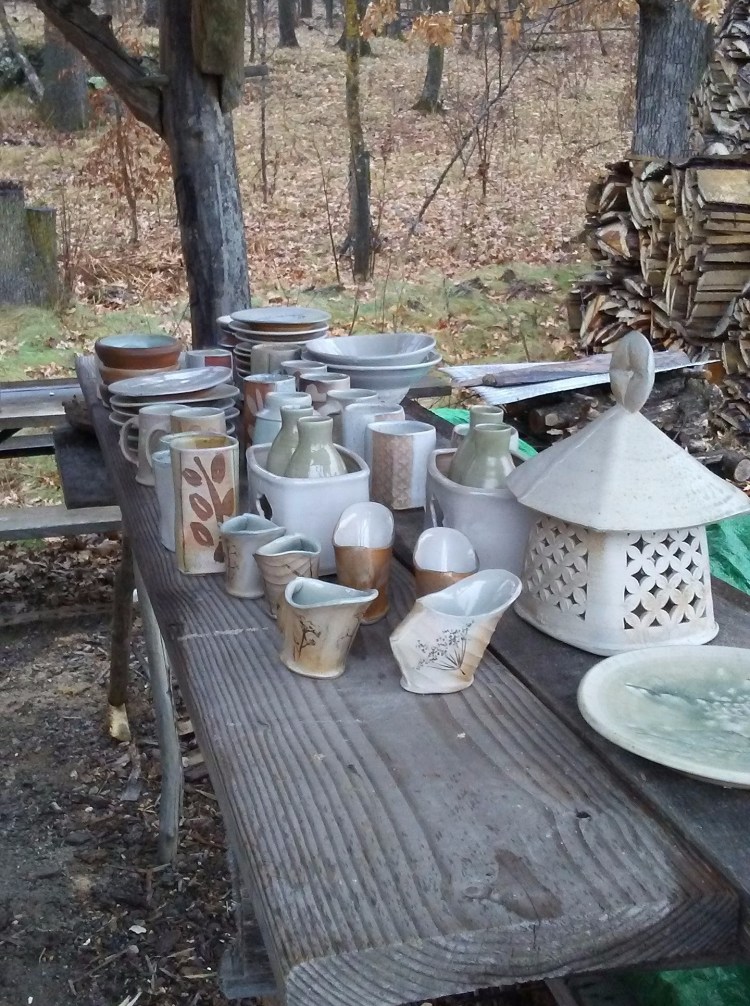
Also a few of the pots from the firing, in their native habitat. Over all it was a really great firing.

20171204_141504.jpg


20171204_141412.jpg

20171204_143118.jpg